
Microscale
SN74LS86N IC
SN74LS86N IC
Couldn't load pickup availability
What it is
The SN74LS86N has four independent 2-input exclusive-OR (XOR) gates in a 14-pin DIP. An XOR output is HIGH when its two inputs are different and LOW when they match. That makes it the building block for binary adders, parity checkers, equality comparators and switchable inverters.
Truth table (each gate)
| A | B | Y |
|---|---|---|
| L | L | L |
| L | H | H |
| H | L | H |
| H | H | L |
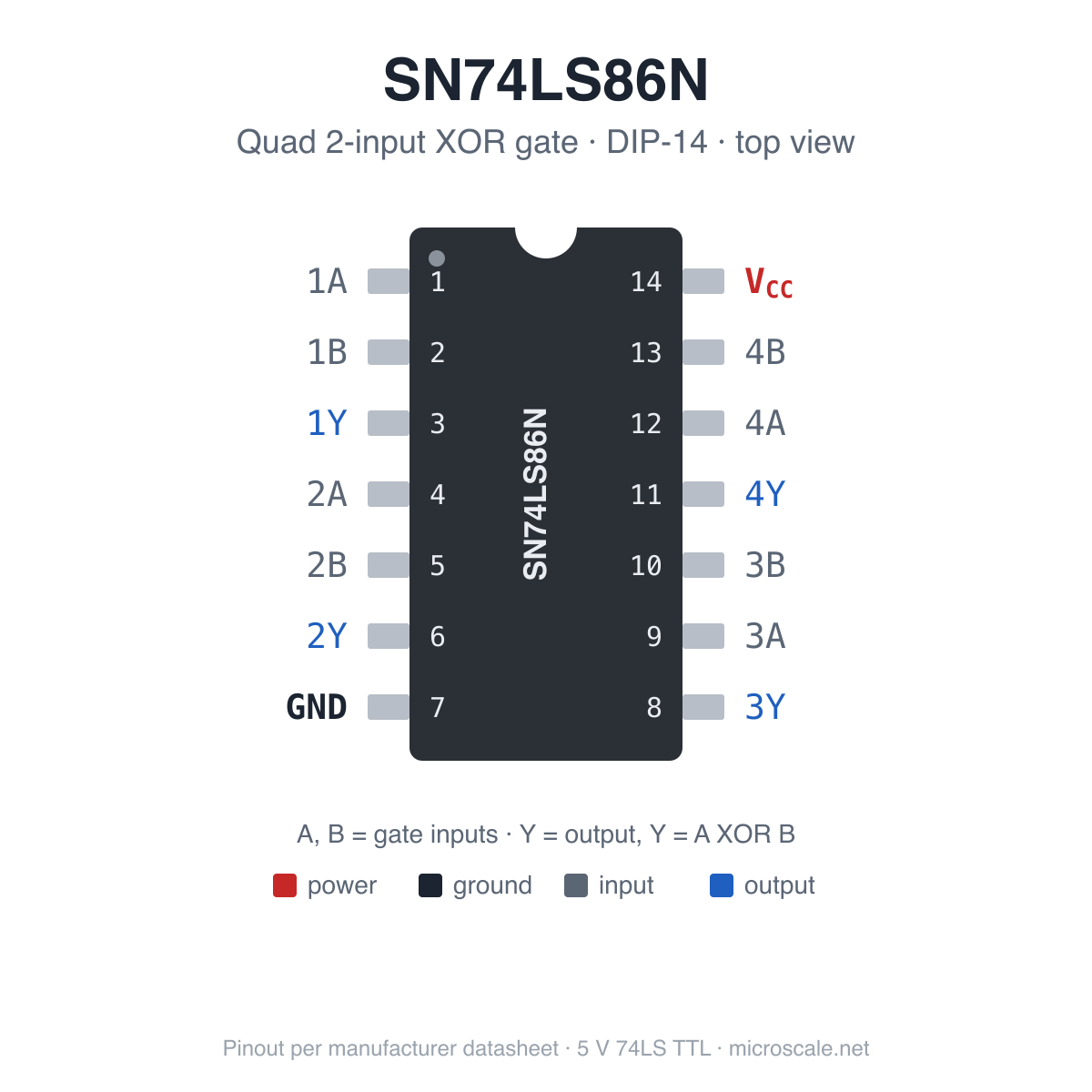
Pinout (DIP-14, top view, notch at the top)
| Pin | Signal | Function | Pin | Signal | Function |
|---|---|---|---|---|---|
| 1 | 1A | Gate 1 input | 14 | VCC | +5 V supply |
| 2 | 1B | Gate 1 input | 13 | 4B | Gate 4 input |
| 3 | 1Y | Gate 1 output | 12 | 4A | Gate 4 input |
| 4 | 2A | Gate 2 input | 11 | 4Y | Gate 4 output |
| 5 | 2B | Gate 2 input | 10 | 3B | Gate 3 input |
| 6 | 2Y | Gate 2 output | 9 | 3A | Gate 3 input |
| 7 | GND | Ground | 8 | 3Y | Gate 3 output |
The pinout is identical to the SN74LS00N: GND on pin 7, VCC on pin 14, gates in the same positions. Only the logic function is different.
Specifications
| Parameter | Value |
|---|---|
| Logic family | 74LS (low-power Schottky TTL) |
| Function | Four independent 2-input exclusive-OR gates, Y = A ⊕ B |
| Package | DIP-14 (PDIP, through-hole) |
| Supply voltage (VCC) | 4.75 V min / 5 V nom / 5.25 V max |
| Absolute max supply / input voltage | 7 V |
| Input HIGH threshold (VIH) | 2.0 V min |
| Input LOW threshold (VIL) | 0.8 V max |
| Output HIGH voltage (VOH) | 2.7 V min / 3.4 V typ at −0.4 mA |
| Output LOW voltage (VOL) | 0.35 V typ / 0.5 V max at 8 mA |
| Output current | −0.4 mA source (HIGH) / 8 mA sink (LOW) |
| Input current | −0.8 mA max LOW / 40 µA max HIGH (2 LS loads per input) |
| Supply current (whole chip) | 6.1 mA typ / 10 mA max |
| Propagation delay, other input LOW | tPLH 12 ns typ, 23 ns max · tPHL 10 ns typ, 17 ns max |
| Propagation delay, other input HIGH | tPLH 20 ns typ, 30 ns max · tPHL 13 ns typ, 22 ns max |
| Operating temperature | 0 °C to 70 °C |
Handy circuits
- Switchable inverter: use one input as a control. Control LOW passes the other input through unchanged. Control HIGH inverts it.
- Half adder: A XOR B is the sum bit. Add an AND (two gates of a 74LS00) for the carry.
- Equality comparator: XOR each pair of bits. All outputs LOW means the two numbers are equal.
- Parity generator/checker: chain the gates. The final output is HIGH when an odd number of inputs are HIGH.
Wiring it up
- 5 V only. 74LS is TTL logic and needs 4.75–5.25 V on VCC. It will not run reliably from 3.3 V.
- Decouple it. Put a 100 nF ceramic capacitor between VCC and GND, as close to the chip as you can.
- Don't leave inputs floating. An open TTL input usually reads HIGH, but it picks up noise and gives random glitches. Tie unused inputs to VCC (directly or through 1 kΩ) or to GND.
- Arduino Uno / Nano / Mega (5 V): connect directly, no level shifting needed.
- ESP32, Raspberry Pi, STM32 and other 3.3 V boards: a 3.3 V output driving a 74LS input is fine (HIGH threshold is 2.0 V). The other direction is not: a 74LS output can sit around 3.4–3.6 V when HIGH, which is above what 3.3 V-only pins accept. Use a divider (1 kΩ in series, 2 kΩ to GND) or a level shifter, or use the 74HC/74HCT version of the chip instead.
- Driving LEDs: 74LS outputs sink current (8 mA) much better than they source it (0.4 mA). Wire the LED and a 680 Ω–1 kΩ resistor from +5 V to the output, so the LED lights when the output is LOW.
- Fan-out: each XOR input is two LS loads (−0.8 mA), so one 74LS output can drive up to 10 of them.
In the package
1 × SN74LS86N in a 14-pin plastic DIP (through-hole, 2.54 mm pin pitch, 7.62 mm / 0.3" row spacing). It drops straight into a breadboard across the centre channel. For soldered builds, use a DIP socket so the chip can be swapped.
The markings depend on the batch: you may get Texas Instruments (SN74LS…N), Hitachi/Renesas (HD74LS…P) or another second-source maker. They are all the same standard 74LS part: same pinout, same logic, same 5 V ratings.
Availability note
Texas Instruments now lists its SN74LS86A as obsolete. The part is still made by other manufacturers and is perfectly good for learning, prototyping and repairing existing equipment. For a new product going into production, use the CMOS 74HC86 (2–6 V supply), which is still in active production.
Datasheet
Texas Instruments SN74LS86A datasheet (PDF)
Related: SN74LS00N quad NAND gate (same pinout)